The Agent Scaling Playbook: What Anthropic's Internal Practices Reveal About the Future of AI Teams
Boris Cherny hasn't written code in eight months. But he's building more software than ever, by managing fleets of AI agents that manage other agents. Here's what his playbook tells us about the future of engineering teams.
In this article
The New Org Chart: Agents Managing Agents
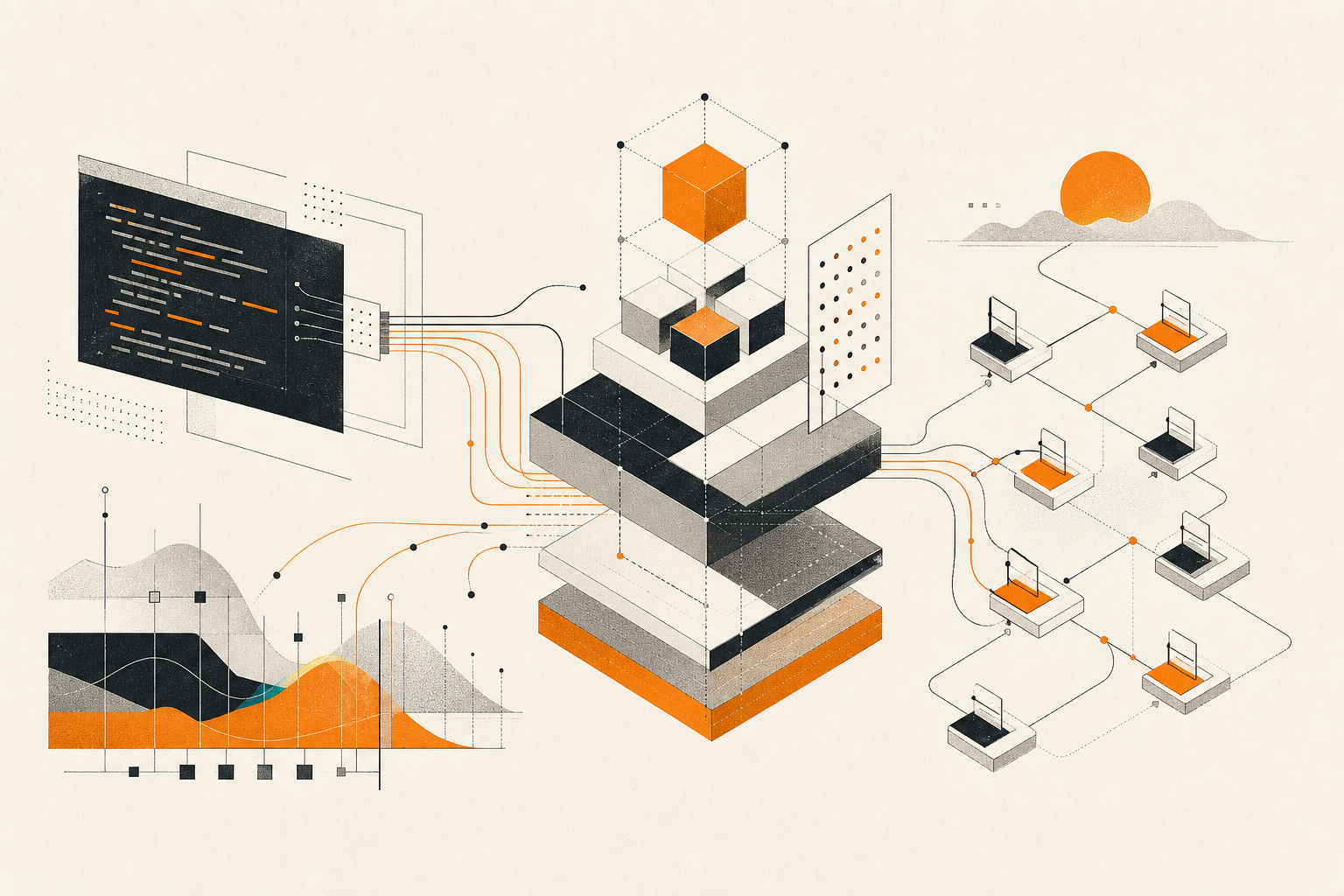
The shift sounds simple when Cherny describes it, but it represents a fundamental rethinking of hierarchy and workflow. A year and a half ago, developers used Claude Code in one terminal window, one instance per person. Today, the model is inverted. One engineer orchestrates a fleet of Claude instances, each responsible for different parts of the codebase or different types of work. Those instances spawn subagents to handle subtasks. The result: the high-level human engineer is no longer prompting Claude directly. Instead, he's overseeing systems where Claude instances are prompting other Claude instances.
For CEOs and CIOs watching this unfold, the implications are stark. The traditional model—'one engineer, one IDE, one task'—is about to become legacy infrastructure. The next model is 'one engineer, dozens of coordinated agents, hundreds of parallel tasks.'
Scale in Action: The Numbers
When Cherny says he manages 'thousands, or tens of thousands' of agents on some days, that's not hyperbole. Those aren't discrete instances running linearly. They're running in parallel, orchestrated across a distributed system, each making decisions, spawning new subtasks, and reporting results back up the chain. On the morning of his conference talk, he checked his work and found that Claude had already taken action on multiple ideas overnight—identifying next steps, suggesting improvements, sometimes implementing them without additional human prompting.
For context: Anthropic is a company of roughly 1,000 people. 8x growth in generated code suggests that the agency-per-human ratio is climbing steeply—possibly dozens of agents per engineer, or hundreds of agent-minutes per human-directed task.
The Architecture: How Anthropic Structures Agent Workflows
While Cherny didn't release detailed architecture docs, the hints he dropped paint a picture of a sophisticated orchestration system. Here's what we can infer:
- Hierarchical task delegation: Humans set high-level goals. Top-level agents decompose those goals into subgoals. Subagents execute in parallel.
- Autonomous decision-making: Agents don't just execute scripts. They evaluate options, flag assumptions, and sometimes push back. Cherny noted that Claude Code 'has ideas'—looking at GitHub and external signals to suggest what should be built next.
- Integration with monitoring: The system works 24/7. Humans wake up to find that overnight, the agent fleet has completed work, identified issues, and staged them for review.
- Self-review loops: Claude Code is doing its own security review. That likely means agents can validate other agents' outputs against test suites, security standards, and consistency checks.
Why This Matters for Your Engineering Organization
If Anthropic's internal practices become the template for how AI-driven teams scale, several things shift:
First, the bottleneck moves. Today, it's often compute or tokens. Tomorrow, it's supervision and orchestration. Anthropic has one person overseeing thousands of agents. That means the real constraint isn't 'how many agents can we spin up,' but 'how effectively can one person orchestrate and validate their work?' This is different from traditional scaling, where you hire more engineers. Here, you're training engineers to be orchestrators, not just coders.
Second, code generation velocity is no longer the constraint. Output is. A team using this model isn't asking 'how many lines of code can we write per month?' They're asking 'how do we validate, integrate, and maintain the code that agents produce at scale?' Security review, testing, integration, and architectural consistency become the critical path.
Third, the role of the engineer changes fundamentally. Cherny put it plainly: 'The role of a builder is just totally changing.' That doesn't mean engineers disappear. It means they become less about executing tasks and more about defining intent, validating quality, and steering systems. A single engineer is overseeing systems that would traditionally require dozens of developers.
The Risk Cherny Acknowledged
Cherny was asked directly if he was worried about recursive self-improvement—AI systems that can autonomously improve themselves. His answer was unambiguous: yes, it's one of the big risks for AI.
He's not alone. Anthropic published 'When AI Builds Itself' in April 2026, detailing how they're using AI to develop future AI models. Taken far enough, this approach could lead to systems capable of autonomously designing, building, and improving their successors. That's the theoretical end state. We're nowhere near it. But the fact that a leading AI lab is moving toward these systems and openly discussing the risks is worth noting.
For businesses building on these technologies, the takeaway is clear: the upside is massive, but so is the responsibility for governance, testing, and oversight.
What This Means for Your Business
If you're a CTO or VP of Engineering, here's what you should be planning for:
- Invest in orchestration infrastructure: Agent-based workflows require better tooling for task decomposition, monitoring, and result aggregation than traditional CI/CD. Your existing DevOps practices may not scale to this model.
- Hire orchestrators, not just developers: The engineers who succeed in this world won't be the ones writing the most code. They'll be the ones who can define system requirements clearly, validate agent outputs, and manage quality at scale.
- Plan for validation and governance: With agents generating code 24/7, your testing, security review, and architectural consistency processes need to be automated and rigorous. Manual review will become a bottleneck.
- Expect a productivity jump, then consolidation: Teams that adopt agent orchestration will see dramatic velocity increases initially. That won't immediately translate to headcount reductions—you'll likely reinvest in quality, features, and scope. But the shape of the team will change.
The Precedent
Cherny made a historical analogy worth considering: the printing press. Johannes Gutenberg's invention around 1440 didn't eliminate the demand for writing. It democratized it. By lowering the cost of reproduction, it expanded the scope of what could be written and who could access it. Eventually, that led to the Renaissance and the Industrial Revolution.
Agent orchestration may follow a similar pattern. It won't eliminate engineering jobs. It will likely expand the scope of what engineering teams tackle, and change which skills are most valuable. The question isn't whether your team will use agentic workflows. It's when, and how well you'll transition into that model.
Sources and Further Reading
Anthropic's Claude Code creator says he manages tens of thousands of AI agents at once — Fortune, June 8, 2026. https://fortune.com/2026/06/08/anthropics-boris-cherny-creator-of-claude-code-says-there-are-days-he-manages-tens-of-thousands-of-ai-agents-at-once/ When AI Builds Itself — Anthropic Blog, April 2026. https://www.anthropic.com/institute/recursive-self-improvement Claude Code Dynamic Workflows Documentation — https://www.anthropic.com/news/dynamic-workflows Fortune Brainstorm Tech Conference 2026 — https://brainstormtech.fortune.com
Get the Claude playbook in your inbox.
One weekly email for Claude and Claude Code users. Real workflows, no hype. Subscribe and we send you The Claude Power-User Cheatsheet.
— ¶ —

Luke Thompson
Luke Thompson is the founder of The Operations Guide, LLC and editor of The Claude Insider. Based in Jonesborough, Tennessee, he has spent years building AI-augmented business systems and automation workflows for operators and teams. He began working with large language models in production well before the current wave of consumer AI tools, integrating them into client workflows, content pipelines, and operational infrastructure. At The Claude Insider, he writes about Claude with the specificity of someone who uses it daily as a professional tool — not as a reviewer or commentator, but as a builder. His coverage focuses on what actually works: prompt patterns, API integration strategies, agentic workflows, and the real-world tradeoffs that practitioners face. He is not affiliated with Anthropic, PBC.
Articles are researched and drafted with AI assistance, reviewed and edited by Luke Thompson.
Know where AI can pay off in your company.
Take the free two-minute AI Readiness Assessment. See your score, the two gaps holding you back, and the next move worth making.